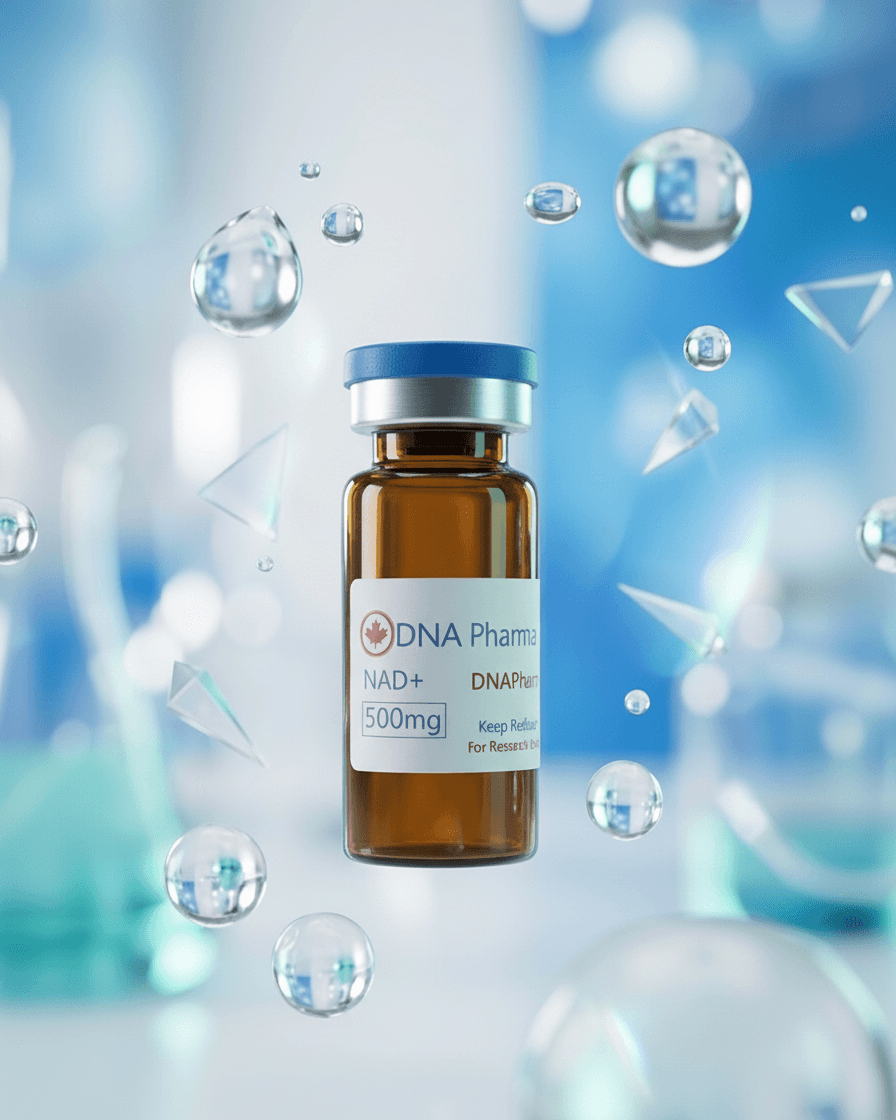






NAD+
500mg
150.00$
NAD⁺ is widely studied for its role in cellular energy production and cellular maintenance processes. Research often focuses on how NAD⁺ levels relate to cellular aging pathways, stress resistance, and metabolic performance in laboratory systems.
NAD+
Product Name: NAD⁺
Type: Cellular Energy Research Compound
Research Focus:
NAD+ (nicotinamide adenine dinucleotide) is a critical coenzyme involved in cellular energy metabolism, DNA repair, and mitochondrial function[1]. Clinical research has primarily employed intravenous infusions at high doses, though subcutaneous administration at lower doses is emerging as a practical maintenance route[2][3]. This educational protocol presents a once‑daily subcutaneous approach with gradual titration for improved tolerability.
Research Interest:
Cellular aging and longevity pathway models
Energy production efficiency studies
DNA repair and cellular maintenance signaling
Oxidative stress response research
Scientific Interest:
Cellular metabolism and ATP production
Enzymatic repair mechanisms
Redox balance in biological systems
Reconstitution:
Reconstitute: Add 3.0 mLbacteriostatic water → 166.7 mg/mLconcentration.
Typical daily range: 50–100 mg once daily subcutaneously (gradual titration from lower doses).
Easy measuring: At 166.7 mg/mL, 1 unit = 0.01 mL = 1.67 mg on a U‑100 insulin syringe.
Storage: Lyophilized: freeze at −20 °C (−4 °F); after reconstitution, refrigerate at 2–8 °C (35.6–46.4 °F) for up to 14 days; protect from light and avoid freeze–thaw cycles.
Cycle:
Standard / Gradual Titration Approach (3 mL = 166.7 mg/mL)
WEEK | DAILY DOSE (MG) | UNITS (PER INJECTION) (ML) |
|---|---|---|
Week 1 | 50 mg | 30 units (0.30 mL) |
Week 2 | 75 mg | 45 units (0.45 mL) |
Weeks 3–8 | 100 mg | 60 units (0.60 mL) |
Weeks 9–12 | 100 mg | 60 units (0.60 mL) |
Weeks 13–16 | 100 mg | 60 units (0.60 mL) |
Frequency: Inject once dailysubcutaneously. This gradual titration protocol begins at 50 mg daily to assess tolerance, as starting too high can produce adverse reactions such as insomnia, anxiety, or fatigue[4]. Most individuals find doses in the 50–100 mg range well‑tolerated after ramp‑up[5]. The 3.0 mL dilution keeps per‑injection volumes practical and allows for accurate unit measurements on standard insulin syringes.
Reconstitution Steps
Allow the lyophilized vial to reach room temperature before opening to minimize moisture condensation.
Draw 3.0 mL bacteriostatic water (0.9% benzyl alcohol) with a sterile syringe.
Inject slowly down the vial wall to avoid foaming; do not aim directly at the powder.
Gently swirl or roll the vial until the powder fully dissolves (do not shake vigorously).
The resulting solution should be clear and colorless. If discoloration or precipitate appears, discard.
Label with the reconstitution date and refrigerate at 2–8 °C (35.6–46.4 °F), protected from light.
Use within 14 days; inspect before each use for clarity.
Note: Each 0.01 mL (1 unit) contains approximately 1.67 mg of NAD+. Example conversions: 50 mg = 30 units; 75 mg = 45 units; 100 mg = 60 units.
IMPORTANT NOTICE:
This product is intended strictly for laboratory research. It is not intended to diagnose, treat, cure, or prevent any disease.

King St. West,
Toronto, Ontario
Canada.
M6K 3M3